DON'T be a Vanderbuilt - get off the high income earner treadmill
Cornelius Vanderbilt died in 1877 as the richest man in America. $105 million — equivalent to about $2.3 billion today.
Forty-eight years later, his family held a reunion. Not a single millionaire sat at the table.
The money wasn't stolen. It wasn't lost in a crash. It was spent — generation by generation, mansion by mansion, lifestyle by lifestyle — until it was simply gone.
What the Vanderbilts Got Wrong
The Vanderbilt descendants were brilliant at one thing: spending money that had already been made.
The second generation doubled the fortune. The third started building estates — the Breakers in Newport, the Biltmore, twenty-plus mansions in New York City. They extracted value from the system instead of reinvesting it, and they never built the infrastructure to stop future generations from doing the same.
Anderson Cooper — CNN anchor and Vanderbilt descendant — has spoken publicly about not inheriting significant wealth. His mother, Gloria Vanderbilt, chose not to, specifically because she felt she had to make it herself. One of history's greatest fortunes, gone in three generations.
What the Rockefellers Got Right
The Rockefeller family took the opposite approach.
From the beginning, John D. Rockefeller structured his wealth around a simple constraint: don't let the money get spent. When new family members were born, whole life insurance policies were placed into irrevocable trusts. The trusts were managed by strictly liable trustees — not the beneficiaries themselves. Nobody could raid the corpus.
The family operates on what's sometimes called the "buy, borrow, die" model. They borrow against the cash value in the policies to fund productive ventures. The policies continue compounding. When a family member dies, the death benefit replenishes the trust and passes to the next generation — income-tax-free.
More than 100 years later, the Rockefeller family office manages tens of billions of dollars. The mechanism is still the same one John D. started.
The Opportunity Cost Nobody Calculates
Every dollar you spend from your own pocket has a cost beyond the transaction.
What could that dollar have compounded into over 30 years? What investment didn't get funded? What policy didn't get capitalized? That's opportunity cost — and for most high earners, it adds up to hundreds of thousands of dollars over a lifetime, lost not to bad decisions but to a leaky system.
You don't need Vanderbilt money for this to apply to you. If you clear $200,000 a year and your account drops to near-zero every January, the mechanism is identical. Scale is different. The problem is the same.
Stop Being the Pass-Through
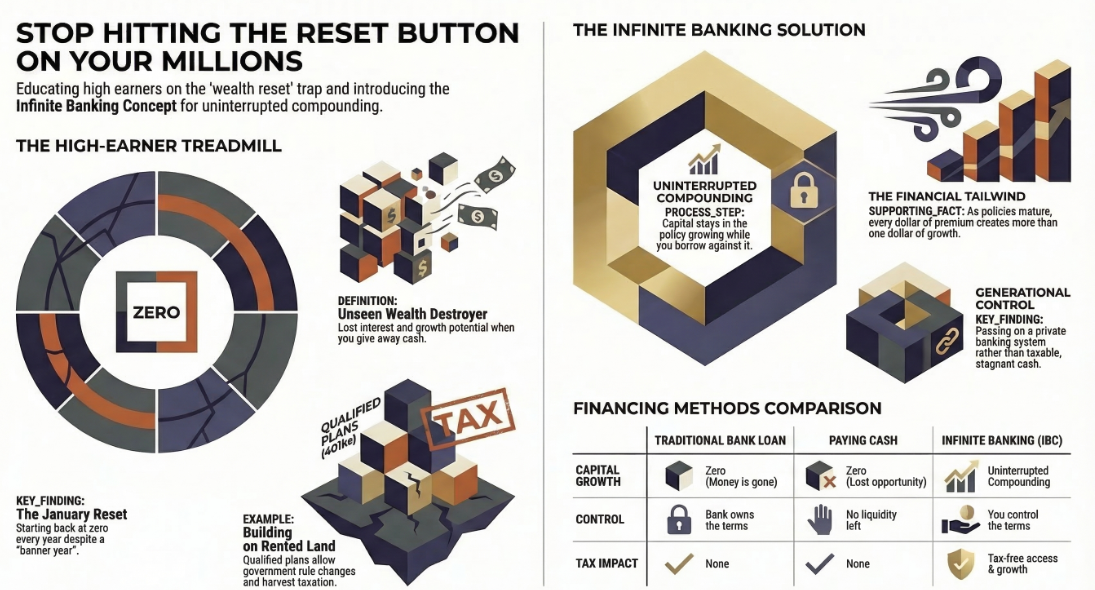
Most high earners function as distribution centers. Paycheck arrives. Mortgage takes a cut. Car payment. Credit cards. Subscriptions. By the end of the month, the money is gone — held by the bank, the lender, the insurer, the government.
You generated all of it. You kept none of the banking function.
IBC is a structural fix. You capitalize a whole life policy. It compounds uninterrupted. When you need capital, you borrow against it rather than spending the principal. You repay it — and the system keeps building.
The money never leaves your ecosystem. That's the Rockefeller model, scaled to a normal human life.
Don't let your year reset in January
The goal isn't to earn more. It's to stop starting over.
Whatever you made last year — whether it felt like enough or not — none of it compounded if it passed through your hands on the way to someone else's system.
Control your capital, or someone else will.
Watch the full episode: DON'T Be a Vanderbuilt on the Wealth Warehouse Podcast YouTube channel.
Photo by Unsplash
Ready to build your wealth warehouse?
Book a free strategy call with David & Paul and discover how IBC can work for you.

