Military Transition Blueprint
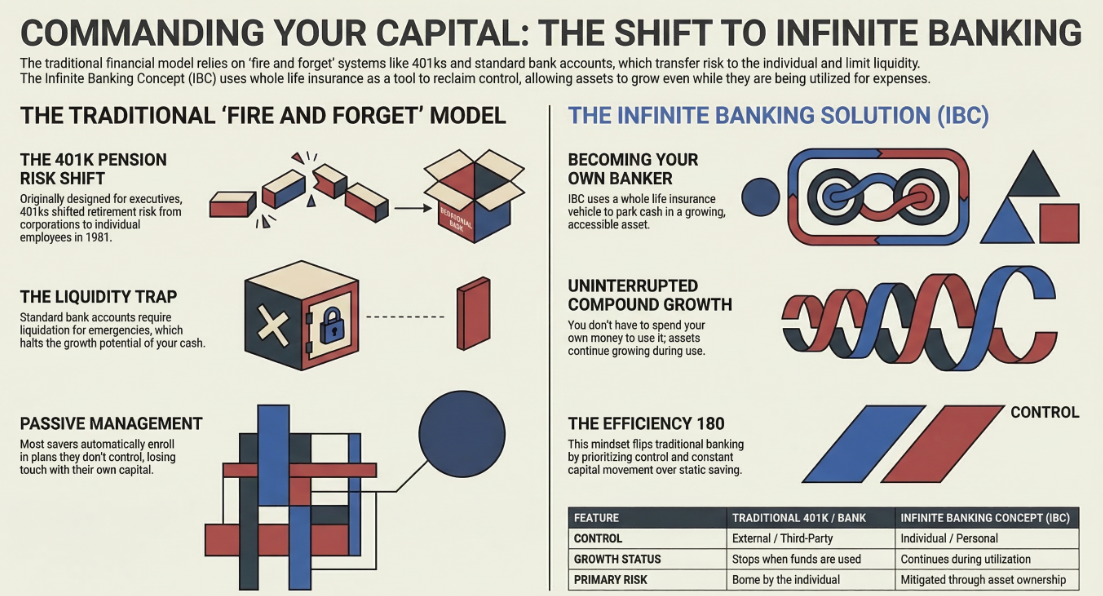
The military teaches you to fire and forget. Launch the asset, trust the system, move on to the next objective.
It's effective in combat. Applied to your retirement account, it's a disaster.
Most service members get processed into a 401(k) at civilian orientation, check a box, and never look at it again. The money leaves the paycheck automatically. "Future Me" is supposedly being taken care of. And then twenty years pass and the math doesn't add up.
How the 401(k) Actually Got Here
In 1981, a benefits consultant named Ted Benna created the first 401(k) plan — originally designed as an executive compensation structure for C-suite employees. Within two years, the IRS approved it for general use, companies realized they could shift pension liability onto employees, and the Great Pension Disappearing Act began.
Before the 401(k), companies carried the risk of funding your retirement. After it, you did. The pitch was simple: we'll match some of what you put in, and the government will defer the tax. It felt generous. It was actually a transfer of responsibility.
Today, trillions of dollars sit in 401(k) accounts. For most Americans — excluding their primary home — it's where the bulk of their net worth lives. Locked up, inaccessible until 59½, and eventually taxable on the government's terms.
That's not a wealth strategy. That's deferred dependency.
The Liquidity Problem Nobody Talks About
Military transition means income disruption. New career, new income level, new timeline. The last thing you need in that window is capital you can't touch.
A 401(k) early withdrawal costs you a 10% penalty plus income tax. In a 28% bracket, a $10,000 withdrawal nets roughly $6,200. You pay $3,800 for the privilege of accessing money that was yours.
Liquidity during transition isn't a luxury. It's a tactical requirement.
Owning the Banking Function
The alternative Nelson Nash described is straightforward: instead of participating in someone else's banking system, build your own.
A whole life policy structured for infinite banking accumulates cash value that is always accessible — no penalty, no credit check, no gatekeeper. You borrow against it, pay it back on your schedule, and the cash value keeps compounding while the loan is outstanding.
For someone transitioning out of the military — potentially starting a business, investing in real estate, navigating an income gap — that accessible capital is the difference between acting from strength and reacting from pressure.
The Process of Banking Doesn't Stop
Interest rates rise. Interest rates fall. The 401(k) contribution limits change. Tax law gets rewritten.
But the fundamental mechanics of banking continue regardless. Money flows. Interest compounds. The question is always the same: are you the customer, or are you the bank?
Service members spend careers executing missions with precision and discipline. That same discipline applied to a capital-building system — started early, funded consistently — produces a very different retirement than a 401(k) parked on autopilot.
Stop firing and forgetting. Your financial future deserves a better targeting system.
Watch the full episode: Military Transition Blueprint — Ep. 210 on the Wealth Warehouse Podcast YouTube channel.
Photo by Unsplash
Ready to build your wealth warehouse?
Book a free strategy call with David & Paul and discover how IBC can work for you.


