Stop Spending Your Own Money
The most expensive thing you do with money isn't a bad investment. It's spending the principal.
When you pay cash for a car, you lose the dollar and you lose everything that dollar would have earned for the rest of your life. Most people never calculate that second number. It's the opportunity cost nobody tracks — and it's where the real wealth destruction happens.
The Vanderbilt vs. Rockefeller Problem
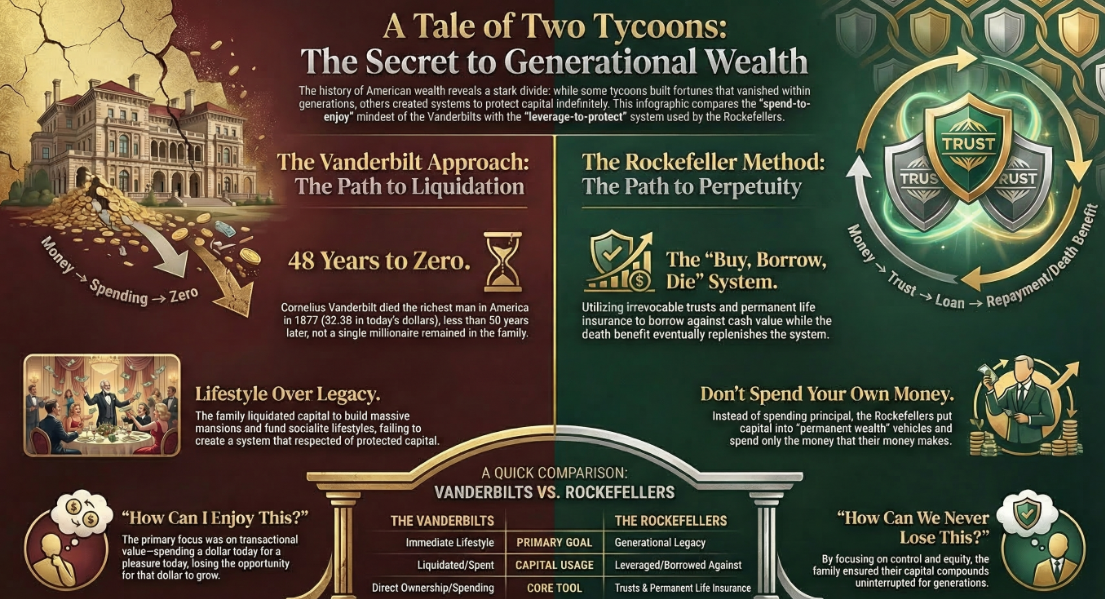
Cornelius Vanderbilt left his family $2.3 billion in today's terms. Within 48 years, not a single millionaire remained in the family.
The Rockefellers started with similar wealth and still manage tens of billions today, more than a century later.
The difference wasn't income. It wasn't intelligence. It was a single question asked at the beginning of every financial decision.
The Vanderbilts asked: "How do we enjoy this?"
The Rockefellers asked: "How do we never lose this?"
One family liquidated assets to fund a lifestyle. The other built systems that prevented liquidation. The Rockefeller model — whole life policies in irrevocable trusts, borrowed against rather than spent, replenished by death benefits at each generation — made the capital structurally immortal.
Why Spending Your Own Money Is the Problem
Here's the mechanic most people miss.
When you spend a dollar, you lose the dollar. When you borrow against a dollar held in a whole life policy, you still have the dollar — it keeps compounding inside the policy while the loan is outstanding. You're using the economic value of the money without consuming it.
This is the core of the Infinite Banking Concept. Your money sits in a dividend-paying whole life policy from a mutual company, growing at a guaranteed contractual rate. When you need capital — for a car, a business, real estate, an emergency — you take a policy loan. The cash value doesn't stop. The interest you pay goes back into a system you own rather than to a lender you don't.
When you repay, you recapitalize your own banking system. Every cycle strengthens it.
Why Mutual Companies Matter
Not all whole life insurance is built for this.
Policies from stock companies — where shareholders own the insurer — don't distribute profits back to policyholders. The cash value grows slowly and the economics don't work for banking.
Mutual companies are owned by policyholders. When the company performs well, dividends are declared and distributed to policy owners. These aren't guaranteed, but the strongest mutual companies have paid consecutive dividends for over 100 years. Dividends sit on top of the guaranteed contractual growth — they're additive, not the whole story.
This distinction matters. The system only works if the vehicle is right.
The Sequence Is Everything
You don't need a different income. You need a different sequence.
Most people earn → spend → start over. Capital never accumulates because it never stays long enough.
The IBC sequence: earn → capitalize the policy → borrow against it when needed → repay → capitalize again. The base never resets. Every repayment strengthens the foundation.
Same discipline. Completely different trajectory over twenty years.
The Vanderbilts had more money than most people will ever see. They still ended up with nothing because the sequence was wrong.
You don't need a billion dollars to make the same mistake. And you don't need one to fix it.
Watch the full episode: Stop Spending Your Own Money on the Wealth Warehouse Podcast YouTube channel.
Photo by Unsplash
Ready to build your wealth warehouse?
Book a free strategy call with David & Paul and discover how IBC can work for you.

