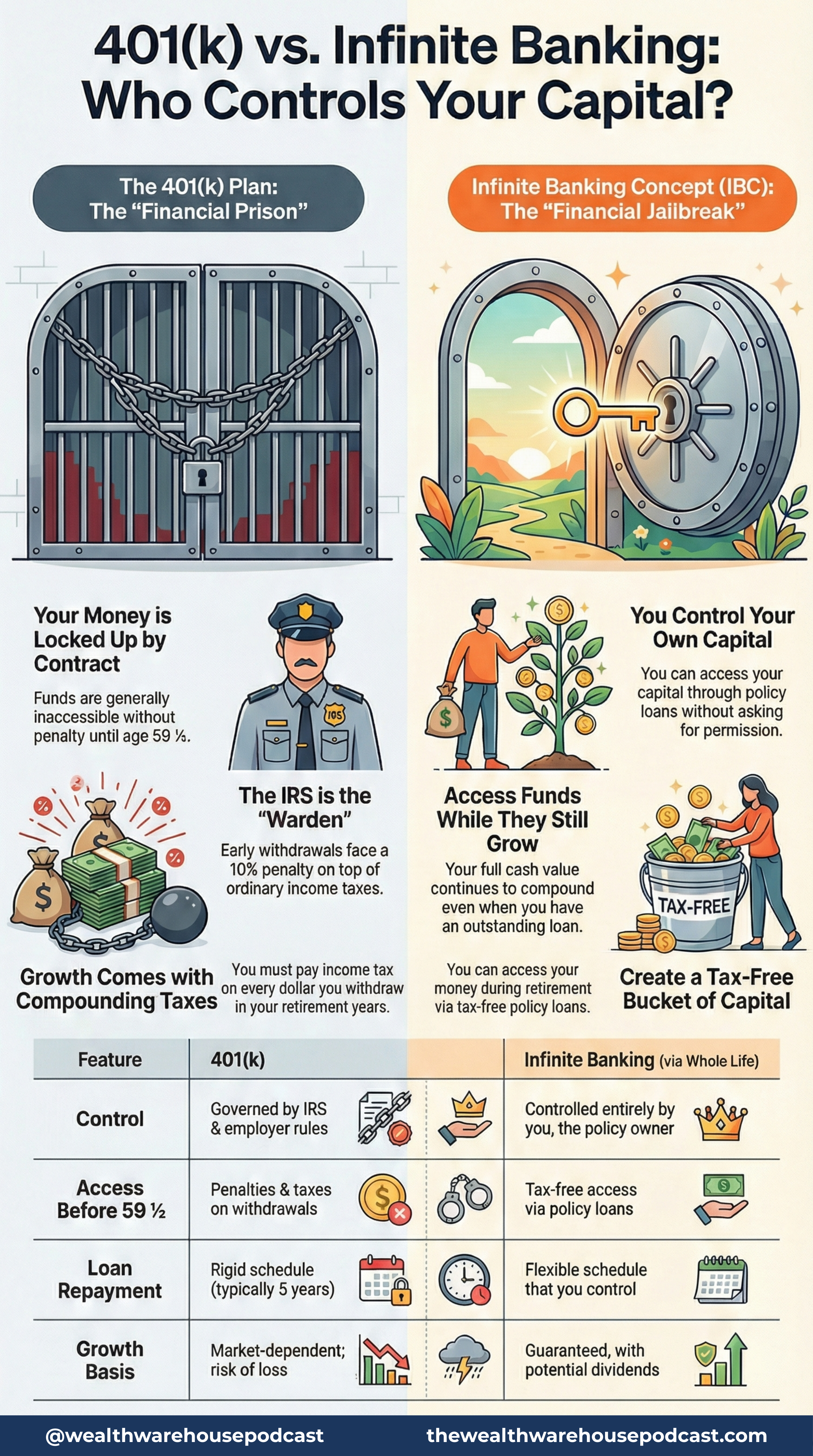
The 401(k) Prison Break
The day you enrolled in your 401(k), you signed a contract most people never read carefully.
You agreed to lock your capital away until you're 59½. In exchange, you got a tax deduction today and a promise that the government will figure out the tax bill later — on their terms, at whatever rate they decide is appropriate when you start withdrawing.
That's not a savings plan. That's a deferred negotiation you're almost certainly going to lose.
The Real Cost of Early Access
If you need your 401(k) money before 59½, here's what it costs: a 10% penalty on top of ordinary income tax. In a 28% bracket, a $10,000 withdrawal nets you roughly $6,200.
You pay $3,800 for the privilege of accessing your own money.
During the 2020 pandemic, this math became real for a lot of people. Clients went to their plan custodians asking for emergency cash and were turned away. The capital was there — on paper — but structurally inaccessible when it mattered most.
Liquidity isn't just about having money. It's about being able to use it.
What the Banking System Actually Wants
Qualified plans exist because the government benefits when your capital is aggregated, managed, and eventually taxed. The longer it stays locked up, the more predictable the future tax revenue.
This isn't a conspiracy — it's just incentives. The system was designed to serve the people who designed it.
Understanding that doesn't require outrage. It just requires a different strategy.
The IBC Alternative
The Infinite Banking Concept works differently at every point that matters.
Your premium goes into a whole life policy structured for maximum cash value. That cash value is yours — accessible via policy loan at any time, for any reason, with no credit check and no penalty. The loan doesn't interrupt the compounding inside the policy.
You finance a car through your policy instead of a bank: you're paying interest back to yourself rather than to a lender. You buy real estate, fund a business, cover an emergency — the capital is always available because there's no gatekeeper.
The contrast isn't subtle. One system asks permission. The other doesn't.
The Same Habits, a Different System
This isn't about spending more or saving more. The people who benefit most from IBC are already disciplined — they're already putting $1,500 or $5,000 a month somewhere.
The question is where that somewhere is, and who controls it.
Stop letting the warden hold your keys.
Watch the full episode: The 401(k) Prison Break — Ep. 205 on the Wealth Warehouse Podcast YouTube channel.
Photo by Unsplash
Ready to build your wealth warehouse?
Book a free strategy call with David & Paul and discover how IBC can work for you.

