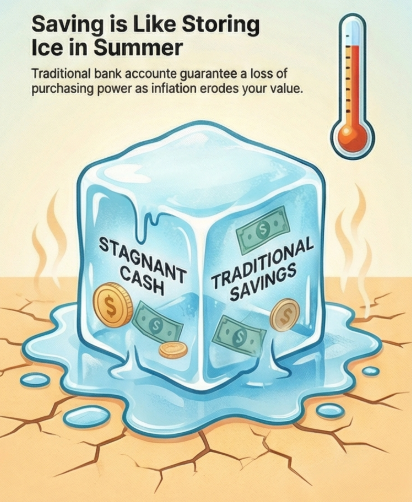
The Inflation LIE: Capitalizing vs. Saving
Saving money is not the same as building wealth. Most people treat them as synonyms. They're not even close.
Saving is storing. Building is growing. And storing something in an environment that actively degrades it isn't a financial strategy — it's a slow loss with a false sense of security attached.
The Ice Cube Problem
Imagine storing ice in the summer. You come back in six months and most of it is gone. You haven't done anything wrong — the environment did it for you.
That's what inflation does to cash parked in a savings account.
You aren't losing dollars. You're losing the purchasing power of those dollars — quietly, consistently, every day. John Elway's 1983 rookie contract paid $1 million per year. To match that purchasing power today, you'd need $3.25 million. Same number, less world.
If you're keeping cash in a savings account earning 0.5% while inflation runs at 3–4%, you're not being safe. You're choosing a guaranteed loss over a visible one.
The FDIC Blanket
Most people find comfort in FDIC insurance. It functions as a kind of psychological guarantee — a promise that the bank has your back.
Here's the part that rarely gets mentioned: banks are required to keep only a fraction of deposits on hand. The system is built on the assumption that not everyone will need their money at the same time.
That assumption holds — until it doesn't. The 2008 financial crisis didn't fail because of fraud alone. It failed because confidence collapsed faster than capital could be produced.
FDIC insurance covers individuals up to $250,000 per account. It does not protect you from inflation. It does not protect you from a bank run. It protects you from one very specific scenario while leaving the more common ones completely unaddressed.
Saving vs. Capitalizing
The real distinction isn't between spending and saving. It's between saving and capitalizing.
Saving: money goes in, sits still, gets spent, starts over at zero.
Capitalizing: money goes into a system, compounds uninterrupted, gets accessed via loans against itself — never stopping, never resetting.
The Infinite Banking Concept is built on the capitalizing model. Your premium funds a whole life policy. The cash value grows at a guaranteed contractual rate, independent of market conditions. When you need capital, you take a policy loan — your cash value keeps compounding while the loan is outstanding.
The money never stops working. That's the difference.
The Order of Operations
The ingredients don't change. You still earn money, you still allocate it, you still use it to live your life.
What changes is the sequence. Instead of earn → spend → zero, the sequence becomes earn → capitalize → borrow against → repay → capitalize again.
It's the same discipline. A completely different result.
Watch the full episode: How to Protect Your Savings from Inflation with Infinite Banking — Ep. 207 on the Wealth Warehouse Podcast YouTube channel.
Photo by Unsplash
Ready to build your wealth warehouse?
Book a free strategy call with David & Paul and discover how IBC can work for you.

